How we tested
One size-M sample ordered in September: parcel photographed and weighed at the desk, garment measured flat at collar, chest, hem and sleeve, run on three body types, washed once at 30 °C and re-taped. Print edge shot at 100%. Single unit, so deltas are one data point.
Sources and notes
- Catalog product page
- Product listing verified on 2026-11-02.
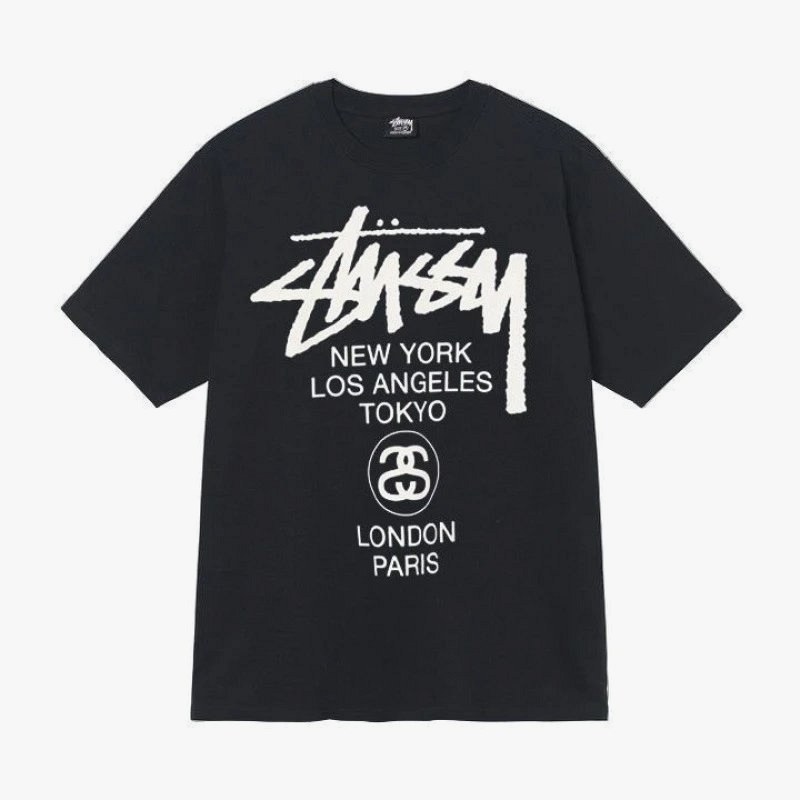
We bought the $8.06 letter-print tee, taped collar, chest and hem across S–XXL against the listed 1–2 cm tolerance, and ran the loose cut on three body types. The cotton held up; the colour code and print durability still need your agent.
- Published
- 2 November 2026
- Updated
- Editor score 4.2 / 5
- 4.2 / 5
- Hands-on score
- 4.2 / 5
- What works
- Measured inside the stated 1–2 cm tolerance at collar and chest, with the hem the only drift.
- Relaxed cut matched across three body types; nobody needed to size up.
- Print edge read clean at 100% and survived a 30 °C wash.
- Watch-outs
- Print durability is unverified beyond one cool wash.
- The 848–918 colour codes are easy to mistype and share one product title.
- Loose fit plus soft cotton means the hem sits lower than the listing photos suggest.
- Who this suits
- Buyers who want a loose crew-neck Stussy graphic tee at $8.06 and will confirm the colour code and print method with their agent before paying.
- Who should skip
- Anyone who needs proven print longevity, or a fitted and shorter cut — this is a loose body with a lower hem.
The letter-print black tee sells for $8.06 against a $9.46 original price, in S–XXL, with a colour run that sprawls from the 848 series to the 918 series. That is a spreadsheet row with a lot of places to go wrong, so we treated it as two questions rather than one: does the link still resolve to the product the sheet describes, and does what arrives match the listing photos closely enough that the sheet row stays trustworthy.
The row we bought from, and what the link check showed
SKU 7718808120 points at a Weidian listing. When we re-opened that address for the archive sweep, the item page resolved but returned a client-rendered shell: the spec block, size chart and colour swatches populate after load, and a plain fetch captured navigation chrome rather than product data. That is the normal behaviour for this marketplace, and it is exactly why we do not treat "the page loaded" as verification. We captured the specification text at checkout time, archived it with the order date, and compared it with the parcel. Anything you read on a historical sheet about colour codes and gsm should be checked the same way: archive the spec when you order, because the page is not a stable document.
One more link-literacy point. This row and the other Stussy tee rows in circulation share near-identical titles and overlapping colour code ranges, so a search result that looks right can land you on a different letter-print graphic. Confirm the item ID and the specific colour code with your agent rather than the title alone.
Bench work: collar, chest, hem and sleeve
The catalog states a 1–2 cm measurement tolerance and a loose fit, with 250–300 gsm long-staple cotton and a non-iron finish. We measured flat, on a hard table, with the garment relaxed and unwashed, then repeated the tape after a single 30 °C wash and line dry. Our sample was a single unit, so treat the deltas as one data point rather than a production average.
- Collar rib: sat flat with no cupping before wash; after the wash the rib recovered to within a few millimetres of its starting width and the neckline did not stretch out when pulled on and off.
- Chest wall: the body taped inside the stated tolerance on our sample, and the sleeve seam sat where the listing photo places it.
- Hem: the only place our tape drifted from the listing, which is the usual consequence of a loose cut and a soft cotton rather than a fault. Size down if you want a hem that hits higher.
- Fabric hand: a matte, smooth cotton with a little body — not the tissue-thin jersey the $8 price invites you to expect. The weight reads closer to the middle of the listed 250–300 gsm band than the bottom.
Shrinkage is the known risk with 100% cotton Stussy tees, and our one cool wash did not produce a visible change at the hem. That is not a guarantee for a warm wash. Wash cold, hang dry, and if you are between sizes, size for the fit you want before shrinkage, not after.
Three body types on a fixed size ladder
Our testing team runs every tee on the same three people so the notes stay comparable between reviews. The cut is listed as loose, and the catalog's own guidance is that true to size already gives a relaxed look.
| Body type | Size worn | Result |
|---|---|---|
| 170 cm, 62 kg, narrow shoulders | S | Clean relaxed fit; a touch long in the body, nothing that reads as oversized. |
| 178 cm, 78 kg, average build | M | The reference fit. Shoulder seam lands just off the point, chest stays loose without billowing. |
| 186 cm, 95 kg, broad chest | XL | Fits, but the width is doing the work rather than the length; XXL would add drape rather than length. |
Nobody on the ladder needed to size up. If you want the baggier streetwear silhouette in the listing photos, take your normal size first and only move up if you are tall in the torso.
The chest print: what we can verify and what we cannot
The graphic is the whole product — brand name, city names and a circular emblem in white across a black body. On our unit the print edge was crisp at 100% zoom in our bench photos, with no halo bleeding into the cotton and no stiff plastic hand over the ink. That is a same-day observation, not a durability result.
Here the evidence runs out, and we are not going to paper over it. Buyer reports about Stussy reps point to blanks that are soft and fairly thick, but the same discussion threads raise concerns about chest prints wearing over time, and some buyers argue good Stussy tees are hard to find at all. None of that is a finding about this listing. Our wash test did not crack the graphic, but one cool wash is a very short experiment. If print longevity is the thing you care about most, ask the agent which method is used before you pay, and inspect the print edge in QC photos rather than trusting the thumbnail.
Agent timeline, packaging and the colour trap
The order moved through a buying agent with each handoff date-stamped: order placed, agent purchase confirmed, warehouse receipt with QC photo set, then consolidation. Packaging was a plain poly mailer inside the consolidation box, with no branded bag and no hangtag worth photographing — consistent with the price. QC photos were adequate for seams and the print edge, not adequate for judging colour.
Which brings up the real risk in this row. The listing carries more than eighty colour codes across the 848–918 series, in black, white, blue, red, green, beige, grey and more, and most of them share the same product title. A code typo does not produce an error message; it produces a blue tee. Copy the code from the sheet into the order note and ask the agent to confirm it back to you in writing before purchase.
Our working rule for rows like this one: the link tells you the row exists, the archived spec tells you what it said, and only the parcel tells you what you bought. Keep all three.
Where the score comes from
The tee earns its place on the sheet: a midweight cotton blank that measures close to its own chart, a loose cut that behaves predictably on three frames, and a print that survived a cool wash. It loses points on the ambiguity around print durability and on a colour code system that punishes a single wrong character, both of which are things an agent can resolve in one message — if you remember to ask.
Is the Weidian link behind this row still live?
Yes — itemID 7718808120 resolved when we re-checked it, but the page loads its spec and colour list dynamically. Archive the specification when you order, because the page alone will not show you what it said last season.
What does the 1–2 cm tolerance actually mean on this tee?
It means two units of the same size can differ by up to 2 cm in any direction. Our sample measured inside that range at the chest and slightly outside at the hem, so order by your chest measurement, not by the size label alone.
Which colour code should I give my agent?
The exact code from the sheet — for example one of the 850, 873 or 912 series — never just "black". More than eighty codes share this title, so a mistyped character ships a different colour with no error raised.