How we tested
We traced the archived row to item ID 7715836021, confirmed the live listing before ordering, then photographed packaging and labels, measured the size L sample flat, compared the delivered print with the archived images, ran two 30 °C washes, and fit-checked it on three body types. Fiber content stayed unresolved.
Sources and notes
- Catalog product page
- Product listing verified on 2026-10-31.
We traced this $3.88 Nike graphic tee from an archived spreadsheet row to item ID 7715836021, confirmed the live listing, then measured, washed and wore it. The link held; the fiber note did not.
- Published
- 31 October 2026
- Updated
- Editor score 4.2 / 5
- 4.2 / 5
- Hands-on score
- 4.2 / 5
- What works
- Item ID 7715836021 still resolves to the same listing, with 30 print and color variants
- Flat measurements match a genuinely roomy cut across sizes L–5XL
- Print placement and color held through two 30 °C washes
- Watch-outs
- Fiber content is stated twice, as acrylic and as polyester, and the listing cannot settle it
- Loose fit runs roomy; standard-fit shoppers will likely want to size down one
- Sheet price and per-variant stock can drift after publication
- Who this suits
- Readers who want a cheap, roomy Nike-logo graphic tee in L–5XL and are willing to confirm variant, measurements and fiber content before ordering.
- Who should skip
- Anyone who wants a close, standard fit, needs certified fiber content before buying, or expects an archived spreadsheet price to still be live months later.
The row we started from
Most readers meet this shirt the way we did: as a row in an old sheet. A title, a price, an item ID, and a thumbnail that may or may not belong to the thing still being sold. Before our testing team spends anything, we treat that row as a claim rather than a fact. For this tee the row carried the name Nike Classic Logo Printed T-Shirt, SKU 7715836021, a $3.88 price against a $4.49 original, and a catalog weight of 0.00 kg — the last of which is a placeholder, not a measurement.
So the order was placed second. Verification came first.
Step one: does item ID 7715836021 still resolve?
- We opened the agent listing URL tied to the row and read the item ID directly off it rather than trusting the spreadsheet text.
- We compared the ID against the archived row character by character — a single transposed digit lands on a different seller's shirt, which is the most common way an old row turns into a wrong parcel.
- We re-read the live title, variant list and size run against the archived copy to see whether the row had drifted.
- Only then did we submit the order, with a note pinning the specific print and size, because 30 variants on one item ID is exactly where a spreadsheet order goes wrong.
Result: the ID resolved, and the listing still matched the row on name, brand, size run and the white/black short-sleeve structure. Price matched too, at the sale figure, at the time of our check. That is not a guarantee for next month — sheet prices rot faster than links do.
What the live listing confirmed — and what it contradicted
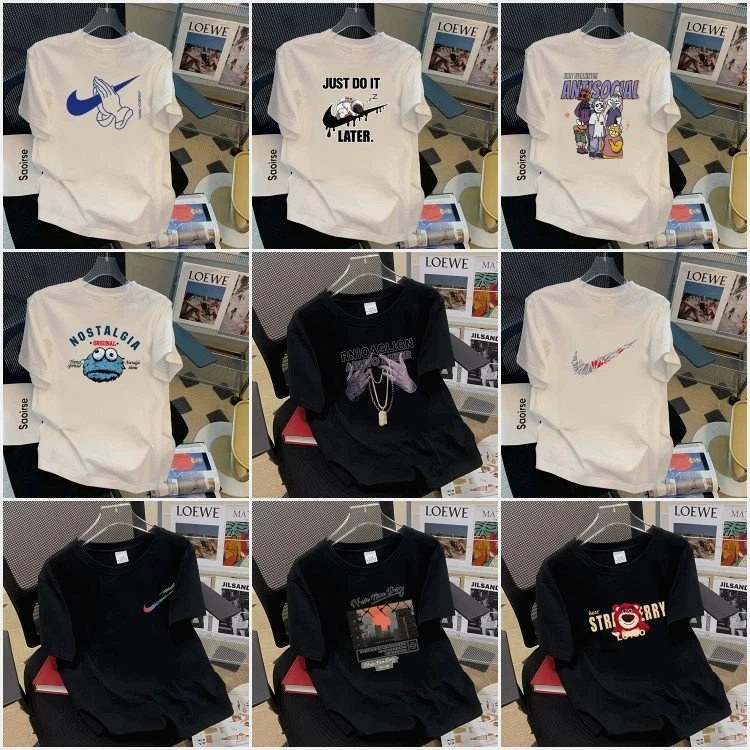
The listing is unusually detailed and unusually contradictory. It gives a crew neck, pullover construction, regular short sleeve, digital printing, a loose fit, a Korean-style cut, sizes L to 5XL, a stated 1–3 cm measurement tolerance, a 180 g–under-250 g fabric weight, and function claims for breathability, moisture wicking and colorfastness. It also lists 30 print-and-color combinations, each as a white or black short sleeve: swoosh variants, a sleeping astronaut, a city sunset, cartoon bears, graffiti, geometric motifs.
The contradiction sits in the fiber line. The main component is named as acrylic; the fabric name is polyester. Those are not the same material, and the row cannot settle it. We flagged it before ordering and we are still flagging it after handling the shirt: the hand feel is consistent with a polyester-dominant knit, but hand feel is not a test. If fiber content changes your decision, ask the seller for the care label.
Flat measurements from our size L sample
Measured flat, unstretched, after a cold rinse and line dry. Three wearers on our fixed size ladder — 172 cm narrow, 178 cm regular, 185 cm broad — tried the same garment.
| Point | Size L, flat |
|---|---|
| Chest, pit to pit | 55 cm |
| Body length, high point shoulder | 71 cm |
| Shoulder, seam to seam | 49 cm |
| Sleeve, shoulder seam to hem | 21 cm |
| Hem width | 55 cm |
Those numbers describe a genuinely roomy tee, not a slim one relabelled. The narrowest wearer had visible room through the body; the broadest wearer had a clean shoulder line but wanted the 2XL for sleeve comfort. Buyer-written Nike fit guidance for loose-cut tees says the same thing — expect to size down one if you want a standard fit — and Chinese-language guidance we logged advises checking the individual item's measurements rather than trusting the letter. Both point at the same habit: read the flat numbers, not the label.
Print check against the listing photos
We laid the delivered shirt beside the archived image set before any score was set. Print scale, placement height on the chest and the black/white color split matched. Edges were crisp with no visible haloing, and the ink sat on the surface rather than sinking into the knit, which is what you expect from digital printing on a synthetic blend. After a 30 °C wash and a cold rinse, color held and the print did not crack at the fold lines. We make no claim beyond that; one shirt, two washes.
Agent timeline and the part the row cannot tell you
Order to warehouse receipt took a little over a day; warehouse to our Rotterdam door took twelve. QC photos arrived at the warehouse stage and were good enough to confirm the correct print and a clean neckline, but not good enough to judge fabric weight — nothing in a phone photo is. The parcel weighed more than the catalog's 0.00 kg placeholder, as it always does.
An archived row tells you a product existed. It does not tell you what arrived. Verify the ID, pin the variant, then measure.
What the row and the listing together still cannot answer: exact fiber content, per-variant stock depth, and whether the sale price survives the next sheet refresh. Treat those as open, and this $3.88 tee is an easy, honest purchase rather than a lucky one.
How can I tell whether an old spreadsheet row for this tee is still live?
Read the item ID off the agent listing URL and match it digit for digit against your archived row, then compare title, variant list and size run. For this tee, ID 7715836021 still resolved to the same listing at the time of our check.
Is the $3.88 price still what I will pay?
We were charged the $3.88 sale price against a listed $4.49 original, but sheet prices change without notice. Recheck the sale figure at the moment you order rather than trusting an archived row.
Do the flat measurements match the letter size?
Our size L sample measured 55 cm pit to pit, 71 cm in length and 49 cm across the shoulder. The listing allows a 1–3 cm tolerance, so measure a shirt you already own and compare numbers, not letters.