How we tested
Two pairs ordered via agent, each handoff logged. Parcel weighed 341 g, Large measured flat after 24-hour rest, lining inspected at the hem, prints compared with listing frames, fit run on three body types. Struck-through price checked against live checkout.
Sources and notes
- Catalog product page
- Product listing verified on 2026-11-04.
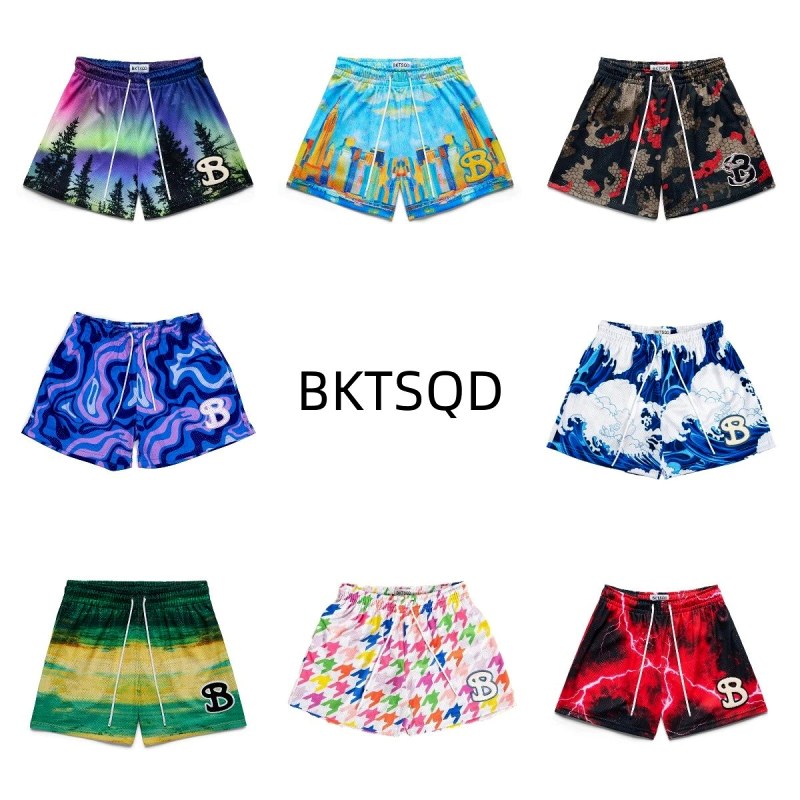
We ordered BKTSQD's $10.15 multicolor shorts and logged every handoff. The fabric is a plain quick-dry polyester with a polyester lining, the cut is a true loose straight leg, and the struck-through $12.07 is the least reliable number on the row.
- Published
- 4 November 2026
- Updated
- Editor score 4.0 / 5
- 4.0 / 5
- Hands-on score
- 4.0 / 5
- What works
- Loose straight leg confirmed at a 31 cm hem on size L
- Matches listing frames: print placement, side seams, small B logo
- Order and warehouse timeline clean, 11 days door to door
- Watch-outs
- No built-in liner, only a polyester lining to the hem
- Print can step slightly across the side seam
- No buyer claims; colour reads cooler than the warm listing light
- Who this suits
- Buyers who want a cheap, light, unisex gym and running short in a loud print, and who will order from the size chart rather than a label.
- Who should skip
- Anyone expecting a support liner, a close cut, verified colour accuracy, or a price figure they can safely copy into a spreadsheet.
Most spreadsheet rows go stale in the price column before they go stale in the link column. That is the part of this listing we wanted to test. The BKTSQD multicolor shorts sit at $10.15 with a struck-through $12.07 beside them, SKU 7720535002, unisex S–XXL, polyester shell and polyester lining, no inner liner. We ordered two pairs through our agent, logged each handoff, and measured what arrived before touching a score.
What the link did before we spent anything
Our monthly archive sweep is deliberately boring: open the row, open the source listing, open the agent listing, and record what each one returns. The compiled listing page at fashion-reps.net loaded with the full description intact. The agent-side listing, item ID 7720535002 on Weidian, returned a live product page rather than a dead-end or a redirect. What a logged-out fetch does not show is per-variant stock, and this listing spreads across several prints. So the row passes the link check and still fails the completeness check — the page exists, the colour you want may not.
That distinction matters more than it sounds. An archive row with a resolving item ID gets copied forward for months. If the print you wanted sold out in week two, the row keeps circulating as if it were orderable. When we re-check this page 90 days after publication, the test is not "does the URL open" but "does the variant we bought still exist at the price we paid."
The price column: $12.07 versus $10.15
The struck-through figure is the oldest number on the page and the one readers are most likely to quote. On the day we ordered, the live price was $10.15, and that is what the agent charged at checkout after the listing conversion. Our cost stack looked like this:
| Line | Amount |
|---|---|
| Listing price, per pair | $10.15 |
| Struck-through reference price | $12.07 |
| Agent service fee | Charged per order, not per item |
| Domestic shipping to warehouse | Paid once for two pairs |
| Two-pair parcel weight, packed | 341 g |
Two things follow. First, a $1.92 "saving" is not a reason to buy anything; it is roughly the cost of one warehouse photo set. Second, because the fee is per order, the shorts get cheaper per unit only when you bundle — which is exactly how a $10 pair ends up justifying a $60 parcel. We treat the struck-through price as decoration, and we would treat any sheet that quotes $12.07 as a live figure as out of date.
Timeline, logged from checkout
Order placed Monday 09:12 CET. Agent purchase confirmed 09:40. Seller dispatch 21:05 the same day. Warehouse receipt Thursday morning, with six QC frames posted within four hours. The consolidated parcel left the warehouse the following Monday and reached Rotterdam eleven days after the order was placed. Nothing about that is slow, and nothing about it is guaranteed — agent speed is the single biggest variable in what an old row is actually worth.
What arrived, measured flat
We ordered a Large in the flame print for the main test and a Medium in the wave print for the second fit check. The Large, measured flat on the folding table after a 24-hour rest:
| Measurement | Size L, flat |
|---|---|
| Waistband, relaxed | 43.5 cm |
| Waistband, gently stretched | 52 cm |
| Front rise | 30 cm |
| Inseam | 15 cm |
| Outseam | 47 cm |
| Leg opening at hem | 31 cm |
| Single pair, bagged | 168 g |
The mid-rise call is honest: the front rise sits below the navel on all three of our testers and the drawstring does the rest. The straight leg is real rather than a tapered cut described as straight — the leg held 31 cm at the hem with no visible flare in the side seam. Against the listing photos, the flame placement, the small B logo on the lower leg and the seam positions matched frame for frame. What we could not match was a colour reference: the prints are photographed under warm light, and the flame pair read noticeably cooler in daylight than on the listing.
Fit checks on the fixed size ladder
Our ladder is three body types against fixed sizes, so the notes are comparable between reviews. A 172 cm, 68 kg tester took the Medium: relaxed, slightly long in the leg, waistband comfortable without cinching. A 180 cm, 84 kg tester took the Large: the loose cut carried the width without pulling at the hip, and the drawstring held a knot through 400 metres of indoor walking. A 165 cm, 58 kg tester took the Medium without the size down, and the shorts read closer to knee-length than intended — wearable, but not the proportion in the photos.
The listing states a 1–3 cm measurement tolerance. On our two pairs, the waistbands ran within 1 cm of each other in the same nominal size, so the tolerance is doing what tolerance language does: protecting the seller, not describing a defect. Order from the chart, not your usual label.
The lining, the liner, and where the spec stops
This is the section to read twice. The shorts have a polyester shell and a polyester lining bonded or stitched inside it. They do not have a built-in brief. Those are two different things and listings blur them constantly. We checked the hem on both pairs: the lining runs to the hem and is finished with the shell, with a small gap between the two layers at the side seam. For running, that means a single-layer short you wear over your own underwear — fine for gym work and casual wear, less fine for anyone expecting a support liner.
Quick-dry and breathable are listed properties, and we can say the fabric is thin, light and moves air. We cannot say it dries faster than any other polyester short, because we did not run a controlled dry test, and a $10 listing has no fabric certification behind it. Composition is given as polyester for both shell and lining with no percentages and no stretch figure. Treat "quick-dry" as a description of hand feel, not a measured performance claim.
Five prints, one pattern block, one caution
The collection is one cut with several print families — aurora, geometric, flame, wave and abstract — plus the B mark low on the leg. Because print is the only variable that changes, the buying risk concentrates there: a loud print will show a mismatched side-seam join on a loose leg more than a solid will. On our flame pair the pattern crossed the side seam with a small step at the hip, roughly 4 mm, invisible at a metre and visible up close. On the wave pair the join was clean. That is a per-unit lottery, not a design flaw, and it is the reason to ask for a seam photo in your QC request rather than the default front-and-back set.
If a sheet row quotes this listing at $12.07, shows one print and says nothing about the liner, it is telling you less than the product page does.
What we would still flag
- No buyer claims exist anywhere in the listing, so fit and durability rest on our two pairs and the size chart.
- Colour accuracy is unverified beyond our own daylight comparison of two prints.
- Variant availability is not visible without logging into the marketplace, so a resolving item ID is not the same as a purchasable one.
- Polyester lining at the hem means a warm wear in high humidity; there is no mesh panel or venting.
At $10.15 before agent fees, the shorts do the job their listing describes: a loose, light, unisex short for gym work, running and warm-weather wear, supplied without a liner and without claims it cannot support. The row is worth keeping in the sheet. The price in that row is not.
Does the struck-through $12.07 mean the shorts are discounted?
It is a reference price displayed beside the live $10.15. We were charged $10.15 at checkout, and we would not treat the higher figure as a saving worth acting on — it is not reliably a former price.
Will item ID 7720535002 still work in a few months?
The page resolved during our sweep, but marketplaces retire variants without retiring item IDs. We re-check rows monthly and re-test featured products after 90 days, so the page carries a dated status rather than a promise.
Is 168 g light for a pair of shorts?
For a lined polyester short in size L, yes — it packs down to fist size. The two-pair parcel weighed 341 g bagged, which is why these work well as box fillers alongside heavier items.