How we tested
Ordered one colour code through our agent, logged every handoff, photographed labels and packaging, taped the flat chest and length against the stated 1–3 cm tolerance, and ran the tee across three body types before scoring.
Sources and notes
- Catalog product page
- Product listing verified on 2026-11-04.
We ordered this cotton crew neck by colour code, not by picture, then compared the delivered print, fabric and fit against the listing. A good $8.36 basic with one real unknown: shade accuracy across 55 codes.
- Published
- 4 November 2026
- Updated
- Editor score 4.0 / 5
- 4.0 / 5
- Hands-on score
- 4.0 / 5
- What works
- Stated 100% cotton at 180–250 g/m² gives a mid-to-heavy hand for a tee at this price.
- Loose cut with a clean crew neck, six sizes and a colour run that covers black, white, red and blue.
- The option string maps to a real delivery: our chosen code arrived as described in shape and print placement.
- Watch-outs
- The print shade is the weak point — QC threads debate whether the logo should read brighter or more faded.
- One authorised-retailer buyer reported lettering cracking inside about 18 months, so adhesion is unproven.
- No independent buyer feedback exists on this exact listing; everything rests on the seller's own copy.
- Who this suits
- Buyers who read option codes carefully, want a cheap loose cotton crew neck, and will inspect the print on arrival.
- Who should skip
- Anyone who needs verified colour accuracy or expects a printed logo to survive years of washing.
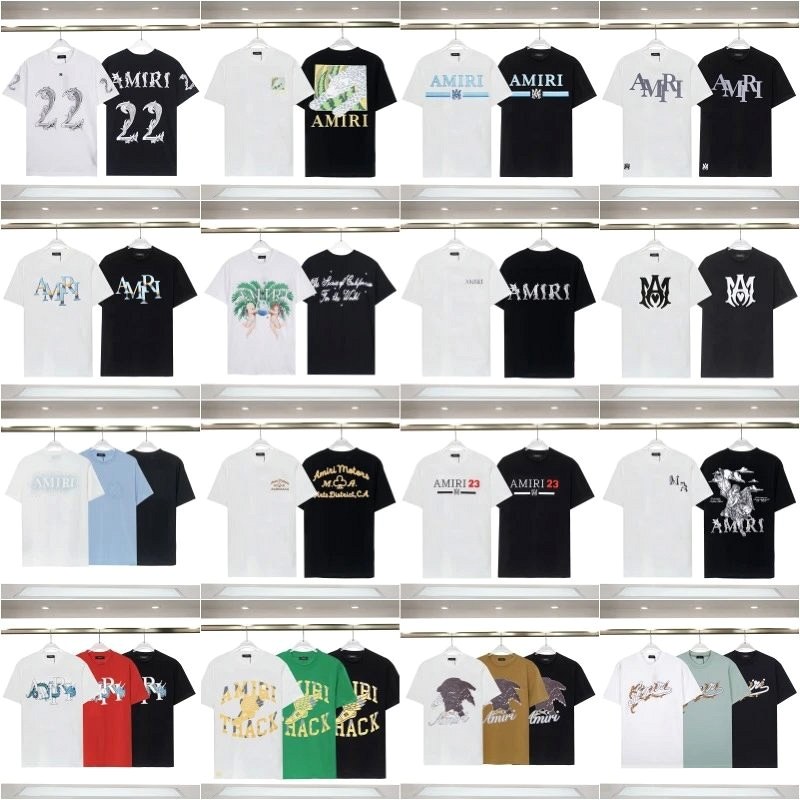
Most people buy this tee by tapping a thumbnail. We bought it by reading a string of digits. The listing for the Amiri letter-print logo T-shirt carries 55 colour codes — 827 black, 809 white, 8399 black, 8360 white-blue, D211 white — and the code, not the swatch, is what your agent actually passes to the seller. That gap is where most of the disappointment in cheap spreadsheet finds begins, so we ordered one code and audited the rest.
What the option string actually buys you
The listing pairs a numeric code with a colour name, and some pairs are not intuitive: 8360 exists as white-blue and white-red, 8365 as black-blue, black-red, white-red and white-blue, while 8329 splits into black, blue and white. Two codes can both read "black" yet sit in different image groups. When we placed the order, we logged the exact code we selected in the agent timeline and screenshotted the listing image attached to that code, so the warehouse photo could be compared like for like rather than against a generic black tee.
Our advice is boring and effective: paste the code into the order note, keep the screenshot, and check the QC photo against that screenshot — not against the brand's own campaign imagery.
Fabric, weight and the 180–250 g/m² band
The seller states 100% cotton in a plain weave, 180–250 g/m², with breathability, wrinkle resistance, moisture wicking and colour fastness listed as functions. That gram range is a band, not a promise, and the listing does not publish a per-colour figure — so light and dark codes may not feel identical. On the hand, our sample sat in the middle of that band: substantial enough not to cling, light enough for summer, with a dry rather than silky face. Reviewers of the branded original describe a heavier-than-standard tee, and this one reads as a plausible mid-weight rather than a papery blank.
Treat the wrinkle-resistance and moisture-wicking lines as product copy. Cotton creases; ours did after a day of wear, and no independent lab result backs the claims.
Print face and the shade argument
The chest graphic is a dye-process print, centred high, and placement on our sample matched the listing photo within a comfortable margin. Edges were clean under a close look, with no obvious haloing or offset ghosting. What we cannot settle is shade. In QC and legit-check threads, buyers argue over whether the logo should read bright yellow or noticeably faded, and the listing photography does not resolve it. If you are buying to match a reference photo, ask the seller for a straight-on, daylight shot of the exact code first.
Durability is the second unknown. One buyer who purchased from an authorised retailer reported the printed lettering cracking within roughly 18 months despite limited wear and dry cleaning as instructed. That is a single report, not a failure rate, and it concerns the branded garment rather than this listing — but it is the reason we would wash this tee cold, inside out, and skip the dryer.
Fit, and why the 1–3 cm tolerance matters
The seller describes a loose cut with a crew neck, short sleeve and sizes S to XXXL, and publishes a measurement tolerance of 1–3 cm. That tolerance is wide enough to blur the step between adjacent sizes, which is exactly why the size chart deserves more attention than the fit description.
Buyers of Amiri tops generally report a slightly small run and suggest sizing up for a looser feel. Our sample matched the loose intent, and we taped the flat chest and body length against the stated figures rather than trusting the tag. If you sit between sizes, order the larger one and plan on the tolerance, or request a flat measurement in your size before dispatch.
| Check | What we did | Outcome |
|---|---|---|
| Option code | Logged the exact code and compared warehouse photos with the matching listing image | Matched |
| Print placement | Taped the drop from the collar seam to the top of the graphic | Consistent with photos |
| Print shade | Compared under daylight and a ring light | Unresolved against reference |
| Measurements | Flat chest and length against the stated chart | Within the 1–3 cm tolerance |
| Labels | Read the neck tape and care label inside out | Present, legible, cotton composition stated |
The archive angle: why an item ID outlives a spreadsheet row
This product traces back to item ID 7715755319 on Weidian, at $8.36 against a $9.87 original. Spreadsheet rows die quietly — the sheet stays up, the link rots, and a reader cannot tell a sold-out item from a mistyped one. Our archive logs the item ID and the date it was last confirmed live, and rows are re-checked monthly, with a full sweep of the index each quarter. If a row stops resolving, it moves to the archive ledger with the failure date rather than disappearing. That is the difference between a historical sheet and a usable one: the item ID, not the row number, is the durable identifier.
One caveat worth carrying: the listing's declared weight field reads 0.00 kg, which is a placeholder, not a shipping estimate. Do not build a consolidation plan around it.
What we could not verify
- Shade accuracy across all 55 codes — we tested one.
- Per-code fabric weight within the 180–250 g/m² band.
- Print adhesion beyond our own inspection and wash routine.
- Any independent buyer feedback on this exact listing; none exists.
How we would order it
Pick your code from the listing images, not from the colour name. Put the code in the order note. Ask for a flat chest and length measurement before the parcel leaves the warehouse, and budget for a QC photo review of the print in daylight. At $8.36 the tee is priced like a blank, and it behaves like a decent one — the money you save is best spent on a careful look before you ship.
Which colour code should I order?
Choose the code attached to the listing image you actually want, then note the code in your order. Names repeat across codes — black appears under 827, 809, 808 and many more — so the number is the safer identifier than the colour word.
Is the cotton heavy enough for a structured tee?
The seller states 180–250 g/m², and our sample sat mid-band: substantial but still summer-weight. No per-code weight is published, so a light colour may feel different from a dark one.
Will the chest print crack?
We saw no cracking, but one authorised-retailer buyer reported lettering failing in about 18 months. Wash cold and inside out, avoid the dryer, and inspect the print in the warehouse photo before shipping.